My Bilt Obsidian Review: Seven Months In, It’s Earned a Place in My Wallet
Hey friends, Phillip here with Points With Phillip!
The Bilt Obsidian card wasn’t my first choice. I originally applied for the Bilt Palladium when applications opened, got denied, and eventually picked up the Obsidian so I could still participate in the Bilt ecosystem.
About seven months later, I’m glad I did.
Between the Obsidian and my Rakuten strategy, I’ve earned roughly 150,000 Bilt points during that time. More importantly, the card fits the way my family actually spends money today: more groceries, fewer dinners out, and travel purchases that help us work toward our next trip.
Here’s what has worked for me, what requires a little more attention, and how I’d think about choosing between Bilt’s three cards.
Why I chose groceries
Since my wife and I had our son, going out to dinner takes considerably more planning. Who’s handling bedtime? What time do we need to leave? Is this restaurant outing worth disrupting the evening?
We still enjoy taking him out, including lunch after church, but we cook at home much more often. That made groceries the obvious choice for my Obsidian bonus category.
The card has a $95 annual fee and earns 3 points per dollar in your choice of dining or groceries, 2 points per dollar on travel, and 1 point per dollar on other purchases. Grocery bonus earnings are limited to $25,000 in spending annually. You can change your initial category selection within 30 days of opening the account; after that, changes are available each January. Bilt’s program details
One of my biggest surprises has been my experience at Walmart and Target. Purchases made in-store with my physical card have earned the grocery multiplier. My Walmart+ purchases haven’t produced the same result.
That’s my experience, rather than a guarantee for every location or payment method. If those stores are central to your strategy, check how your own transactions earn before building your entire setup around them.
The accelerator makes things interesting
Obsidian and Palladium cardholders can redeem $200 in Bilt Cash to activate an additional point per dollar on their next $5,000 in eligible everyday spending. You can activate this up to five times annually, and an activation expires once you reach the spending limit or the calendar year ends.
With Obsidian, that means eligible purchases can earn:
4 points per dollar in your selected dining or grocery category, subject to the grocery cap.
3 points per dollar on travel.
2 points per dollar on other everyday purchases.
The accelerator requires the Flexible Bilt Cash rewards option. It also has a cost: that $200 in Bilt Cash could potentially be used elsewhere. Bilt’s accelerator rules
I’ve already put it to use on travel. When we paid for an Airbnb on the Isle of Skye, my active accelerator brought the earning rate on that purchase to 3 points per dollar.
That’s the kind of purchase where I enjoy seeing this strategy come together: something we were already booking, earning points toward another trip.
Housing rewards deserve a separate calculation
Bilt’s rent and mortgage rewards add another layer, but it’s easy to overstate the earning rate if you combine everything into one number.
With Flexible Bilt Cash selected, everyday purchases earn 4% in Bilt Cash alongside their regular points. You can then redeem Bilt Cash to unlock housing points. Alternatively, Bilt offers Housing-only rewards, where the housing multiplier depends on everyday spending relative to your housing payment. How Bilt’s rewards options work
Under the Flexible option, $30 in Bilt Cash unlocks 1,000 housing points, up to the eligible monthly payment limit. You can’t spend the same Bilt Cash on both housing points and an accelerator. Bilt Cash redemption details
For me, the useful question is how many total points my actual spending and housing payment can generate—and what I give up by choosing one redemption over another.
The hotel credit helps, if I use it
Obsidian includes $100 in annual Bilt Travel Hotel credits, split into two $50 portions. Eligible reservations must be booked through Bilt Travel and cover at least two nights. Bilt’s current rules accommodate both prepaid and eligible post-pay bookings, with different credit timing. Hotel-credit terms
On paper, $100 in credits exceeds the $95 annual fee. But I haven’t used mine yet, so I’m not going to pretend the card has already paid for itself.
A credit is valuable when it reduces the cost of something I would otherwise buy. If I have to arrange an extra stay to use it, that changes the calculation.
Why I like pairing it with Sapphire Preferred
I’ve considered how Obsidian fits alongside my Citi Strata Premier, American Express Gold, and Chase Sapphire Preferred.
The Sapphire Preferred pairing makes particular sense for how I’m using Obsidian: groceries go on Bilt, and dining goes on Chase.
Sapphire Preferred earns 3 points per dollar on dining. Its grocery bonus applies to eligible online grocery purchases and excludes Target, Walmart, and wholesale clubs, so it doesn’t cover my ordinary in-store grocery shopping the same way. Chase’s earning rules
That gives each card a clear job without requiring me to rethink every purchase.
Where Blue and Palladium fit
The other Bilt cards serve different needs:
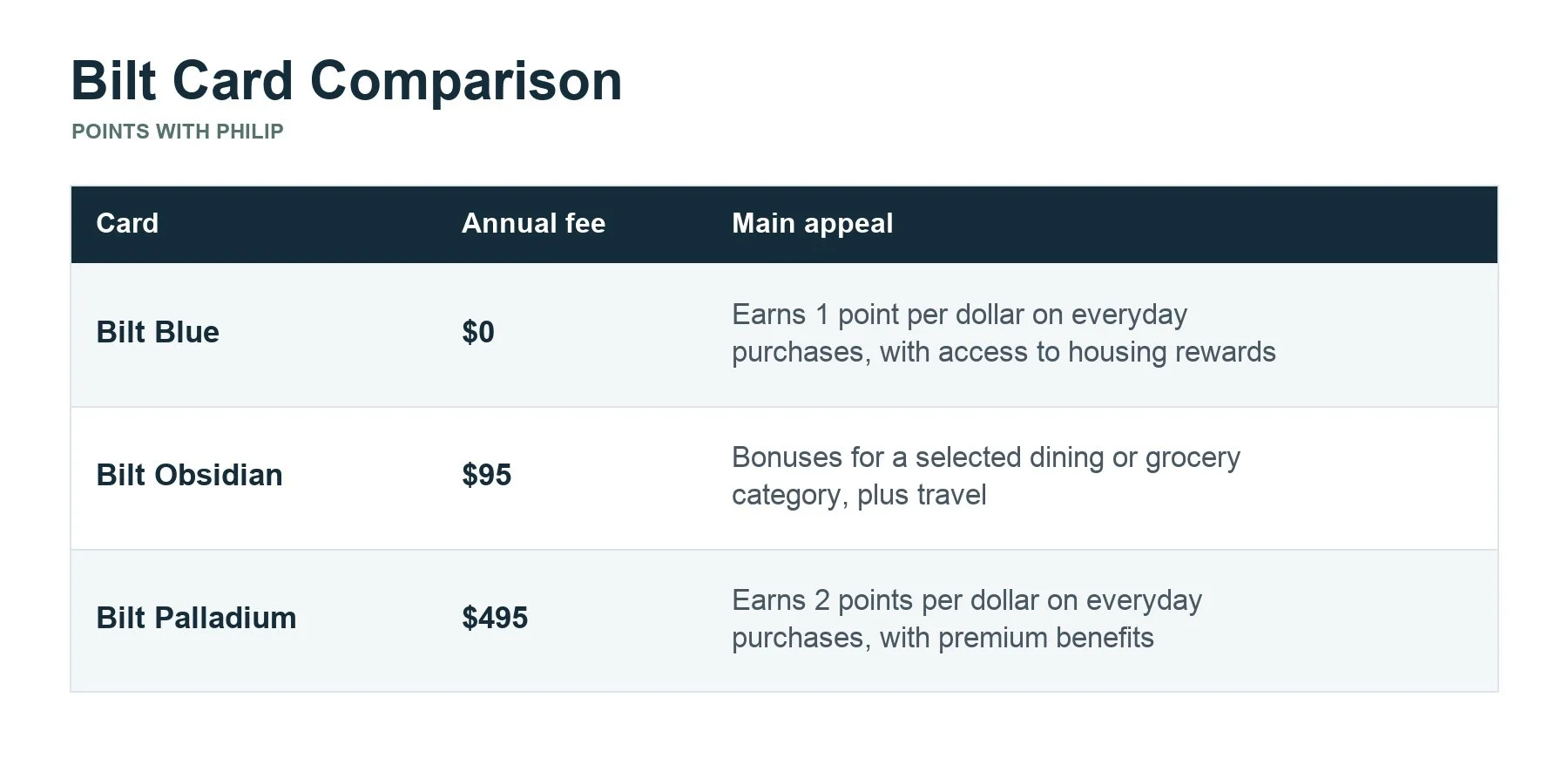
Each of the Bilt credit cards has something unique to offer.
Palladium also includes $400 in annual hotel credits, $200 in annual Bilt Cash, and Priority Pass access. Blue doesn’t have access to the point accelerator. Compare Bilt cards
Palladium still appeals to me as a card for spending outside bonus categories. But the larger annual fee also means I need to get real use from its benefits.
Blue is interesting for someone who wants access without an annual fee. Its housing rewards can improve the overall return, but I wouldn’t describe it as an unconditional 2-points-per-dollar card. Everyday purchases earn 1 point per dollar; housing rewards are a separate part of the equation.
Rakuten has helped grow my balance
Before I buy something online for our family, I check Rakuten. Combining that shopping habit with my Rakuten credit card and Bilt earning has helped me build that roughly 150,000-point balance over the past seven months.
Bilt currently advertises a limited-time conversion of $10 in eligible Rakuten cash back into 1,000 Bilt points for all members. Check the terms when linking your accounts, since promotional rates can change. Bilt and Rakuten
The habit matters more than chasing a purchase: start with something I already need, compare the price, and see whether Rakuten adds value.
What I want to do with the points
Most of the Bilt points I’ve transferred so far have gone to Hyatt. Atmos Rewards is another option I’m excited about. Both are listed among Bilt’s transfer partners; American Express Membership Rewards itself is not a transfer destination. Bilt’s redemption options
I’m also interested in booking through Bilt Travel. Bilt advertises direct travel redemptions at 1.25 cents per point, giving me a useful comparison against transferring points. Bilt Travel redemption information
Living in Orlando, I’ve been particularly excited to see Disney-owned hotels appear in my portal searches. Properties such as the Grand Floridian and Wilderness Lodge could make for a fun family stay, depending on availability and pricing.
I haven’t made that redemption yet. Before booking, I’ll compare the portal total with the direct price and decide whether the experience is worth the points.
Would I choose Obsidian again?
I’d give Palladium another look, but I’d take Obsidian much more seriously from the beginning.
It fits our grocery spending, has been useful for travel, and earns points I’m excited to redeem. I also appreciate having a smaller annual fee and fewer hotel credits to work into our plans.
With around 50 cards in my rotation, keeping everything organized matters. I’ve used MaxRewards for about three years to help monitor transactions, due dates, and available offers. That organization helps me keep a complicated hobby manageable.
Obsidian started as my backup choice. Seven months later, it has a clear purpose in my wallet—and that matters more to me than having the most expensive card in the lineup.
Which Bilt card fits your spending best: Blue, Obsidian, or Palladium? Let me know in the comments.