
Bilt Adds Amtrak as a Transfer Partner: Why This Matters More Than You Might Think
Bilt just gave us another reason to pay attention—and this time, it involves trains.
On September 23, Bilt announced Amtrak Guest Rewards as its first rail transfer partner. Members can now transfer two Bilt points into one Amtrak point, opening another way to use rewards for everything from a quick city getaway to a cross-country train adventure. Read Bilt’s announcement.
The transfer ratio might not sound exciting. But the numbers deserve a closer look, especially if you regularly travel through the Northeast or have a scenic train trip on your bucket list.
What interests me most is the bigger possibility: Bilt is expanding what a travel transfer partner can be.
What are you actually getting for your Bilt points?
A 2:1 transfer ratio means a ticket costing 1,500 Amtrak points requires the equivalent of 3,000 Bilt points.
That doesn’t automatically make it a poor redemption. The cash price of the ticket matters just as much as the transfer ratio.
For example, a $40 ticket available for 1,500 Amtrak points delivers about 2.67 cents per Amtrak point. Because you need twice as many Bilt points, your value is approximately 1.33 cents per Bilt point.
Here are several examples from my searches:
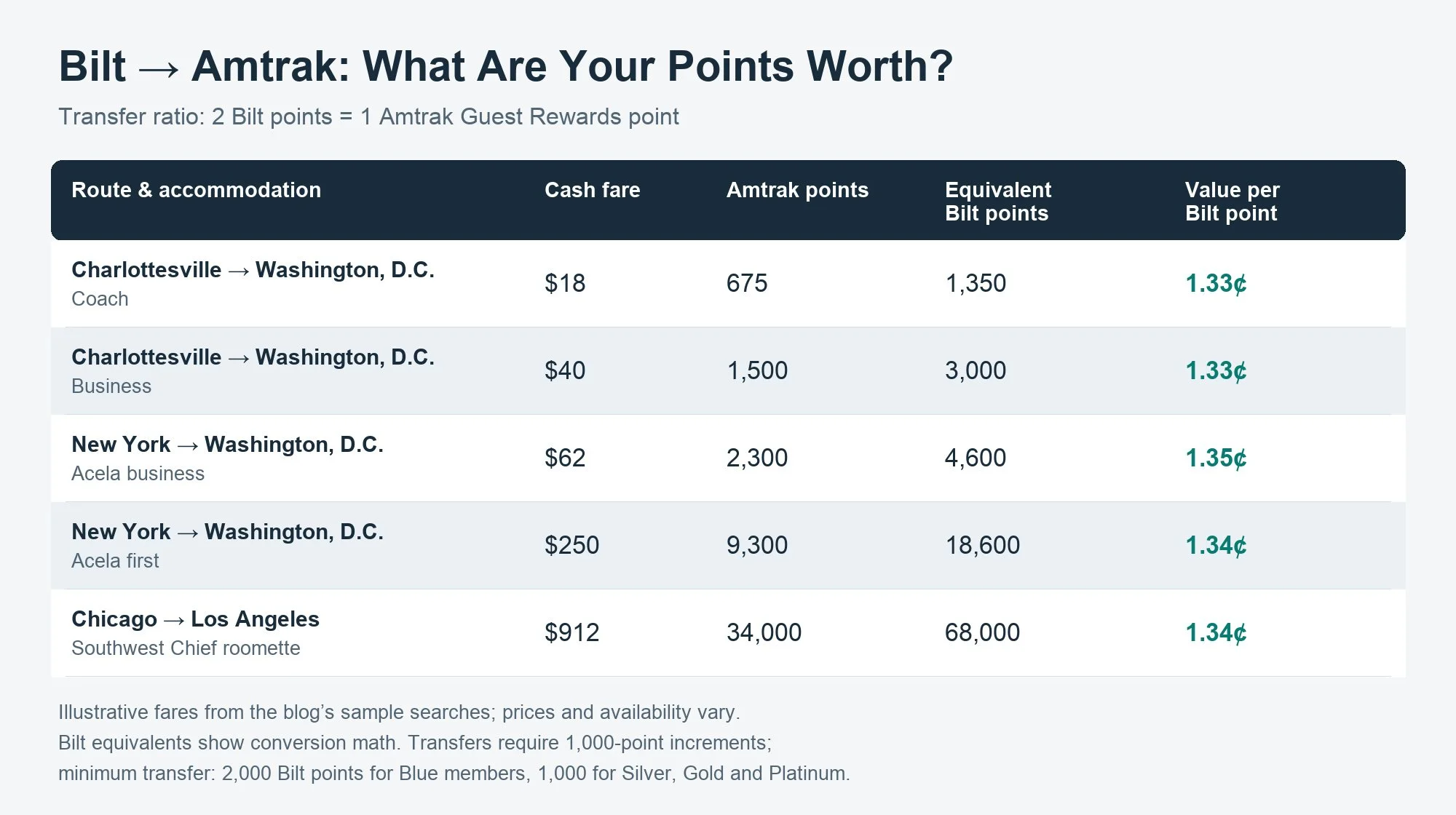
These are examples from the searches discussed here, not currently guaranteed fares. Prices and availability vary. Bilt-point equivalents show the conversion math; actual transfers must follow Bilt’s minimums and increments.
That last detail matters for inexpensive tickets. Bilt transfers occur in 1,000-point increments, with a 2,000-point minimum for Blue members and a 1,000-point minimum for Silver, Gold, and Platinum members. You may need to transfer more than the exact amount required and keep the remaining Amtrak points for another trip. Bilt transfer details.
These examples land closer to 1.33–1.35 cents per Bilt point than 1.25 cents. That’s useful value when it pays for a trip you already want to take.
Where this partnership makes the most sense
When I attended classes at the University of Virginia, I regularly took the train from Charlottesville to Washington’s Union Station.
The appeal was simple: the travel time was competitive with driving, and I didn’t have to deal with parking once I arrived.
That’s the kind of trip where this partnership can be useful. You don’t need a luxury redemption or an elaborate itinerary. Sometimes, getting where you need to go with less hassle is enough.
The New York–Washington route is another good example. In my searches, Acela business class appeared at $62 or 2,300 Amtrak points—the equivalent of 4,600 Bilt points before transfer rounding.
For my travel style, downtown-to-downtown service makes that compelling. A short flight still involves reaching the airport, clearing security, boarding, and traveling from the arrival airport to your destination. Depending on where you’re starting and ending, the train can be a much simpler day.
Longer routes require a different calculation. My Washington–Boston searches showed roughly seven to eight hours on the train, depending on the service. At that distance, I would compare flights carefully.
A reasonable points redemption doesn’t automatically make the train the best choice. Your time matters, too.
The bucket-list possibility: a cross-country roomette
The example that caught my attention most was Chicago to Los Angeles on the Southwest Chief.
My search showed a roomette for approximately 34,000 Amtrak points or $912. At Bilt’s transfer ratio, that becomes 68,000 Bilt points, delivering about 1.34 cents each.
The journey was roughly 44 hours. For this trip, though, the journey would be the reason to book.
I like the idea of slowing down, watching the scenery change, and spending a couple of days experiencing parts of the country I would otherwise fly over. It’s the kind of trip I could imagine taking with my son if he develops an interest in trains.
Before booking a sleeper, compare the room types and price the reservation for everyone traveling. A room’s capacity doesn’t mean a fare searched for one traveler covers a second passenger.
Can an Amtrak credit card make the redemption better?
There’s another layer for regular Amtrak travelers.
The Amtrak Guest Rewards Preferred Mastercard has a $99 annual fee and lists a one-class upgrade, a station lounge pass, and a round-trip companion coupon upon account opening and each anniversary. It also offers a 5% points rebate when redeeming points for Amtrak travel. Amtrak’s card benefits.
That rebate can stretch your Amtrak balance. On an eligible 34,000-point redemption, 5% would return 1,700 Amtrak points for future use. You still need the full amount upfront.
An upgrade coupon could also make a lower-priced booking more enjoyable, but the rules are important. Amtrak says one upgrade coupon covers one customer on one train. It does not automatically upgrade two people for an entire round trip. Coupons also have specific redemption windows, so check the terms before building a trip around one. Amtrak’s coupon instructions.
I would treat any upgrade as an additional benefit, rather than assume a business-class redemption guarantees first class. And the card’s annual fee only makes sense if you’ll use enough of its benefits.
Why I’m watching what comes next
Amtrak is useful on its own. But adding a rail category also makes me curious about where Bilt could go next.
As someone who lives in Florida, I would love to see a future Brightline partnership. Being able to use transferable points for a train trip to South Florida could add another practical option to my travel plans.
That is a wish, not an announced benefit. Bilt currently lists Amtrak under its rail transfer partners. Bilt’s partner list.
I would also welcome a future option to book Amtrak through Bilt’s travel portal with points, particularly if those bookings qualified as paid tickets that earned Amtrak rewards. Whether that would offer better value would depend on the actual booking terms and redemption rate.
For now, the confirmed opportunity is the transfer partnership.
Will I use it?
I already have Amtrak points to use, so I’m not rushing to move my Bilt balance.
Still, I’m glad this option exists. For travelers who regularly take Amtrak, it creates another way to cover a familiar expense. For others, it could help fund a scenic trip they’ve been thinking about for years.
My approach would be straightforward: find the train you want, compare its cash and points prices, account for the 2:1 transfer ratio, and decide whether the savings justify using your Bilt points.
The value here is having another useful choice—and I’m excited to see where Bilt takes that next.
Would you use Bilt points for a Northeast train trip, or save them for a cross-country adventure? Let me know in the comments.