
My Favorite Cards for Groceries: What I Use at Costco, Walmart, Target, and Beyond
Hey friends, Philip here with Points With Philip!
Groceries are one of those spending categories where we have plenty of rewards cards to choose from—and plenty of opportunities to use the wrong one.
The card that earns great rewards at your neighborhood supermarket might earn just its base rate at Walmart. Your favorite points card might not work at Costco’s checkout. And ordering groceries online can earn differently from buying the same items in person.
That’s why my grocery strategy starts with where I shop. Then I decide whether I want cash back or travel points.
Here’s how I think about warehouse clubs, big-box stores, and traditional supermarkets—and why Bilt Obsidian has become such an interesting part of my setup.
Warehouse clubs: start with what’s accepted
Costco, Sam’s Club, and BJ’s deserve their own category because buying groceries at a warehouse club doesn’t automatically qualify for a credit card’s supermarket bonus.
Costco adds another consideration: U.S. warehouses accept Visa credit cards, while Costco.com also accepts Mastercard. Debit cards are another payment option. That distinction matters when choosing a card for an in-store shopping trip. Costco payment policies
For cash back at Costco, two cards stand out to me.
The Robinhood Gold Card earns 3% cash back on eligible purchases. That’s a strong return without needing a grocery bonus category. However, it requires an annual Robinhood Gold subscription, so I include that membership cost when evaluating its value. Robinhood Gold Card details
The Fidelity Rewards Visa Signature is another straightforward option. It earns unlimited 2% cash back when rewards are deposited into an eligible Fidelity account. I like that simplicity: buy what you need, earn rewards, and avoid worrying about whether the purchase qualifies as groceries. Fidelity card details
For travel rewards, my pick from this group is the Capital One Venture X. It earns 2 miles per dollar on ordinary purchases, including warehouse shopping. Its $395 annual fee means I’d evaluate it as part of my overall travel setup, rather than getting it solely for groceries. Venture X benefits
Two miles per dollar can be useful when they contribute to a trip I’m already planning. But 2 miles and 3% cash back aren’t directly interchangeable—the better choice depends on how I’ll redeem those miles.
PayPal Debit and Venmo deserve a closer look
The PayPal Debit Card is another option worth checking. Its monthly category program offers 5% back on up to $1,000 in selected-category spending, with rewards awarded as points. Groceries are one of the available categories. That means the maximum category reward is $50 per month. PayPal rewards details
The attraction is obvious, but I would confirm that my particular store qualifies and check the redemption options in my account before making it my main grocery card. I wouldn’t assume that every warehouse transaction will earn the bonus.
The Venmo Credit Card also needs an update from the version many of us know.
Venmo says cardholders approved before September 24, 2026, earn 3% in their highest spending category, 2% in the second-highest category, and 1% elsewhere. For cardholders approved after that date, the structure changes to emphasize dining, entertainment, and eligible Venmo checkout purchases. Venmo’s current rewards rules
If you already have the older version, your category strategy may still be useful. If you’re applying now, don’t assume you’re getting the same grocery setup discussed in older reviews.
Walmart and Target: store-specific rewards can be hard to beat
I’m selective about store cards, but Walmart, Target, and Amazon are places where I can see a clear reason to carry one.
At Walmart, the OnePay CashRewards Card earns 5% back with a linked Walmart+ membership or 3% without one. The card has no annual fee, although Walmart+ is a separate membership consideration. Also, be careful about the product name: the Walmart Spend Card is a different product and doesn’t include the same standard rewards program. Walmart’s OnePay card comparison
At Target, the Target Circle Card gives you a 5% discount on eligible purchases. That applies to the debit and credit versions, subject to exclusions.
This is an immediate discount rather than 5% cash back to redeem later. Certain purchases, including prescriptions and Target GiftCards, don’t qualify. Target Circle Card discount rules
What I like about these options is that their usefulness extends beyond food. If your shopping cart includes groceries, clothes, and household supplies, eligible purchases across those departments can benefit.
Amazon groceries: Prime Visa is worth considering
For eligible Amazon purchases, including Amazon Fresh orders, and purchases at U.S. Whole Foods Market, Prime Visa earns 5% back with an eligible Prime membership. Prime Visa rewards details
That makes it an appealing option if you already shop within Amazon’s grocery ecosystem.
I’d keep delivery costs separate from the card decision. Earning 5% back doesn’t automatically make an order cheaper once delivery fees, tips, membership costs, and item prices are included. I want to compare the final bill, not just the rewards percentage.
Why I’m using Bilt Obsidian for groceries
For points, the Bilt Obsidian Card is one of the most interesting options in my wallet.
It has a $95 annual fee and lets you select dining or groceries as your 3-points-per-dollar category. The grocery bonus applies to up to $25,000 in annual spending. I chose groceries because I already have other cards I like for dining. Bilt card details
The pleasant surprise has been my experience using the physical card in person at Walmart and Target: those purchases have earned the grocery multiplier.
That’s a personal data point, not a promise that every store or payment method will produce the same result. My online purchases haven’t earned the same way, so I pay attention to how each transaction posts.
Bilt’s point accelerator can make the card more rewarding. Eligible Obsidian cardholders using the Flexible Bilt Cash option can redeem $200 in Bilt Cash for an extra point per dollar on their next $5,000 in eligible everyday spending. There’s a limit of five activations annually, and each activation expires at the spending limit or calendar year-end. Bilt accelerator terms
That can bring qualifying grocery purchases to 4 points per dollar while the accelerator is active and I’m within the grocery cap.
There are two details I keep separate. First, the accelerator costs Bilt Cash that I could use elsewhere. Second, earning additional points on rent or mortgage payments doesn’t turn the grocery purchase itself into a 5-points-per-dollar transaction. Housing rewards contribute to my overall return, but they’re a separate calculation.
Traditional supermarkets: Amex Gold is still a favorite
For eligible U.S. supermarket purchases, the American Express Gold Card remains one of my favorite points options.
It earns 4 Membership Rewards points per dollar on up to $25,000 in U.S. supermarket purchases per calendar year, then 1 point per dollar. The annual fee is $325. Amex Gold benefits and pricing
The U.S. restriction matters. Taking the card to a supermarket abroad won’t trigger that same supermarket bonus. American Express also excludes superstores and warehouse clubs from its supermarket definition. Membership Rewards category terms
For someone who spends consistently at qualifying supermarkets and gets useful value from the card’s other benefits, Gold can make sense. But the annual fee belongs in the calculation.
For my own spending, Amex Gold and Bilt Obsidian are both appealing. My choice depends partly on which points I want for upcoming travel and whether I have a Bilt accelerator active.
Capital One Savor: a simple option with no annual fee
The Capital One Savor earns unlimited 3% cash back at grocery stores, excluding superstores such as Walmart and Target, and has no annual fee. It also earns 3% on dining, entertainment, and popular streaming services. Capital One Savor details
I’ve enjoyed using Savor when traveling, too. When my wife and I visited Paris, we picked up fruit, cheese, and fresh bread from a local supermarket and enjoyed dinner on our hotel balcony overlooking the Eiffel Tower.
That’s a good reminder that grocery shopping can be part of the travel experience. Some of my favorite meals have been simple ones we put together ourselves.
In my own Capital One setup, I’ve also used the ability to move Savor cash-back rewards into Venture miles. That gives me flexibility between taking cash back and building toward travel.
Citi Strata Premier: useful across several everyday categories
The Citi Strata Premier is another card I like because groceries are only one part of its usefulness.
For a $95 annual fee, it earns 3 ThankYou points per dollar at supermarkets, restaurants, gas stations, and EV charging stations, plus 3 points per dollar on air travel and other hotel purchases. It also has no foreign transaction fees. Citi Strata Premier details
That’s a broad set of categories for someone who wants fewer cards to manage. I’d consider it especially seriously if Citi’s transfer partners fit the trips I want to book.
The travel wording matters here: the bonus covers specified travel categories, so I wouldn’t assume every purchase loosely connected to a trip earns 3 points per dollar.
Chase Sapphire Preferred: online groceries are the key
The Chase Sapphire Preferred deserves a place in this conversation, but its grocery bonus is more specific.
It earns 3 points per dollar on eligible online grocery purchases, excluding Target, Walmart, and wholesale clubs. Ordinary in-store supermarket purchases generally earn the base rate. Chase Sapphire Preferred earning rules
Eligible grocery pickup or delivery orders can fit that category. Simply using a phone or app to pay doesn’t guarantee that a transaction will qualify.
For me, Sapphire Preferred works better as a companion to an in-store grocery card than as my only grocery solution.
How I choose what to use
My starting point is the store, followed by the reward I actually want:
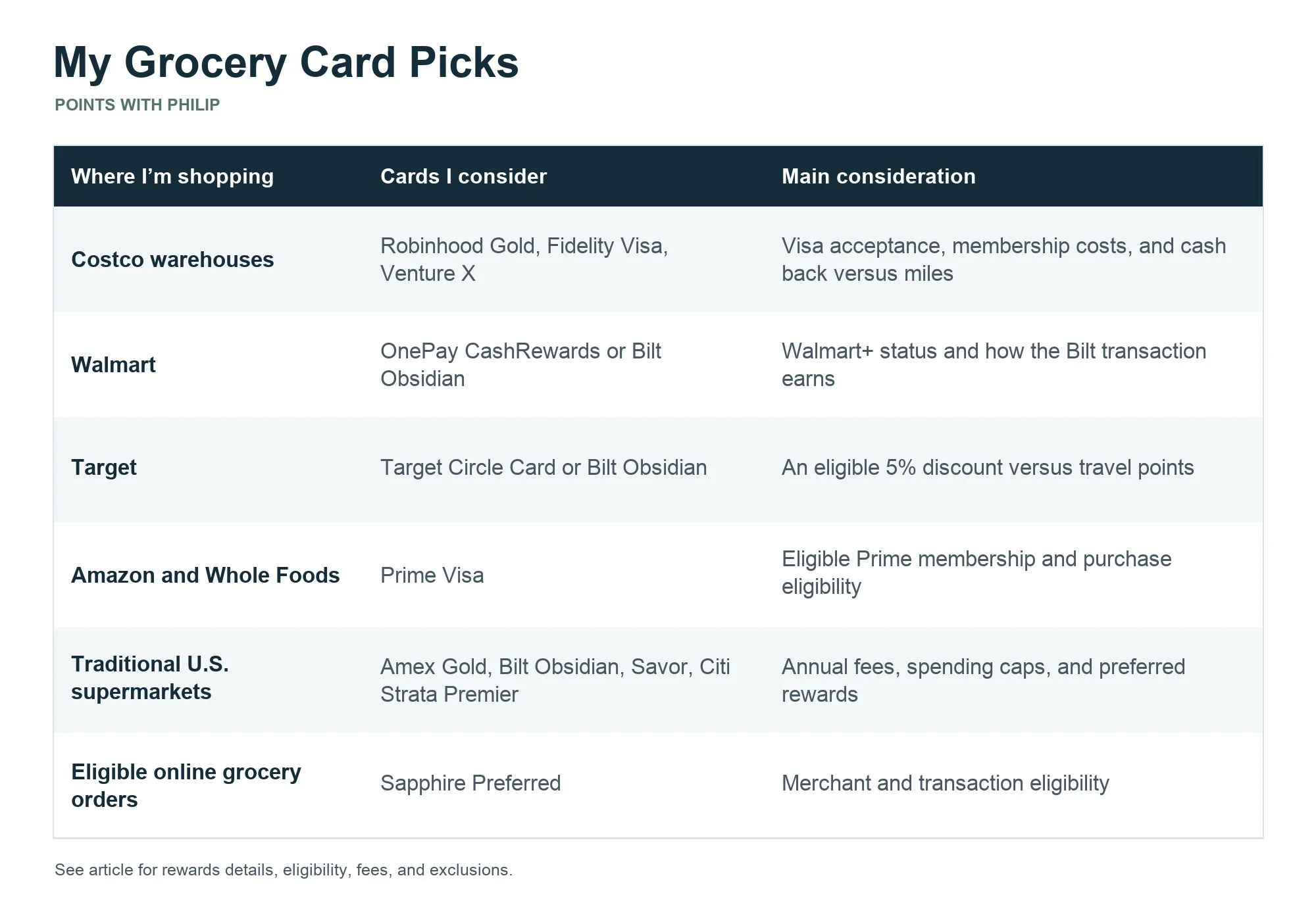
Keeping track of multiple cards also matters. I’ve used MaxRewards to help monitor purchases, due dates, and card offers, and it has helped me save money through offers I might otherwise have missed.
But you don’t need my entire collection to earn useful grocery rewards. A card that reliably rewards your main store, paired with a good option for other purchases, can cover a lot.
Personally, I’m happy to mix cash back and points. A 5% discount can be a great result. So can earning points that help pay for a trip my family wants to take. I choose based on the purchase in front of me and the value I expect to get.
What are you using for groceries right now? Are you earning travel points, taking cash back, or switching cards depending on the store? Let me know in the comments.
Until next time,
Philip
Points With Philip